There is knowing that you are somewhere and knowing you are within somewhere.
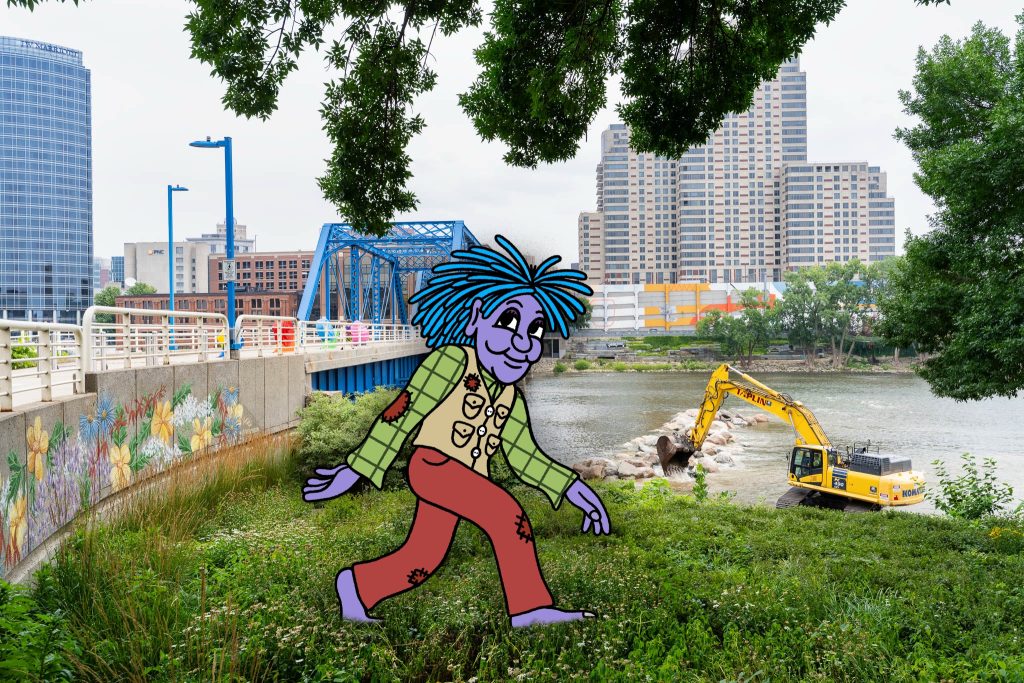
For example: I know that I am in Grand Rapids when I see the Blue Bridge. I know that I am in Grand Haven when I spot the glowing red lights and a catwalk leading into Lake Michigan. I know that I am in Ada when I emerge from metal sails, past the meeting of the Thornapple and Grand, and meander toward the covered bridge.
From buildings to intersections to murals, placemaking happens in the iterative storytelling of place – landmarks, literally, are the stories of sites that help us place where we are. Stories formed these landmarks. Then, new ones reinforced their iconography.
One of the most powerful ways we see our stories come to life is through public art.
Passing under the Gillett Bridge for the first time on a tour of the river with my new colleagues, my eyes shone at the interlacing and multi-subject stories painted over concrete. I couldn’t help but smile at the sputtering audio meant to be an interactive overlay. I saw nearly the whole of the Grand in a slow 365-degree turn, and still only glimpsing moments in the riparian centuries that culminated into this moment on the river.
I knew where I was. I saw the stories of the place I stood. And I understood, in an instance quickly multiplying as the tour went on, how this place prized the integral connection between people, water and art. Life. And I became a part of it, too.
The thumbprint of Grand River communities, across time, is woven into public art.
Public art is where a place can “become.” This can manifest through, museums, storefronts, interactive installs and murals that mirror back the kaleidoscopic cultures and ecologies that we contribute to everyday.
Public art brings our infrastructure to life and deepens community stake and sense of place. Instead of art being somewhere you have to go, public art is where you already are. As a reflection of place and people, the many forms of public art are unique in their accessibility, which deepens cross-community sense of belonging. It is not static; public art, done right, is a node within a lifetime of community-making and iterative, individual storying.
Like the river, art brings us out and together.
Especially along the river, public art bridges histories and cultures for a lasting sense of place. This is how we will know that we are within the river. Right now, community partners in the Grand River corridor are working to create a holistic, inclusive and dynamic public art plan that brings Grand River communities together and their stories to life.
Art is an integral part of the ever-evolving (or, ever-teaching) public riverfront development, placemaking and experience. Visit our Projects page for more of the Grand River Public Art Plan, slated for implementation in late 2026.